
To find the best marketing automation tools for your business, you should evaluate Better Blog AI for SEO and content, HubSpot for all-in-one CRM and lead nurturing, and Zapier for connecting disparate software workflows. These tools allow you to automate repetitive tasks like email sequencing, social media scheduling, and organic traffic generation by setting up "if-then" triggers. Most founders can implement a basic automation stack within 48 hours to significantly reduce manual operations.
Marketing automation is no longer a luxury for high-growth SaaS companies; it is a fundamental requirement for survival. As a founder, your time is your most expensive asset. Spending it on manual data entry, individual email follow-ups, or manual keyword research is a recipe for stagnation. If you are ready to reclaim your time, Better Blog AI automates the entire SEO and content lifecycle so your organic traffic scales while you focus on high-level strategy. By implementing a structured automation strategy, you move from a reactive state to a proactive growth engine.
In this guide, you will learn how to identify the right tools for your specific stage of growth, how to implement them without breaking your current workflows, and how to measure the return on investment (ROI) of your automated systems. We will cover everything from high-level SEO automation to specific CRM configurations and the evolving landscape of AI-driven marketing.
Prerequisites for Marketing Automation
Before you begin selecting and implementing tools, you must have a few foundational elements in place. Attempting to automate a broken process will only result in "automated chaos." Ensure you have the following ready:
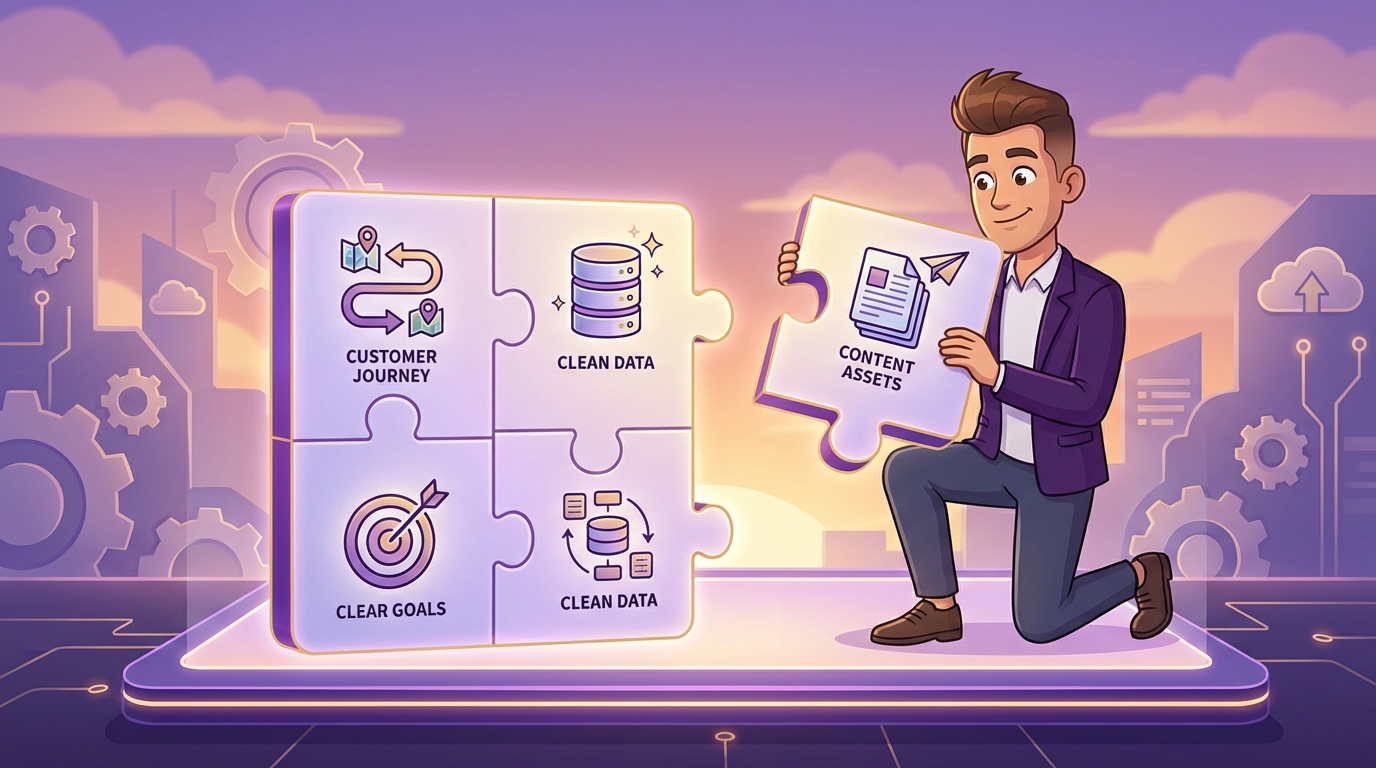 A professional cartoon illustration depicting the foundational building blocks required for successful marketing automat
- A Defined Customer Journey: You must know the steps a lead takes from first discovery to final purchase.
- Clean Data: If your current lead list is full of duplicates or outdated information, your automations will fail.
- Clear Growth Goals: Are you looking to increase lead volume, improve conversion rates, or reduce churn?
- Content Assets: Automation requires fuel, which usually comes in the form of blog posts, whitepapers, or email copy.
Marketing Automation AI: The New Standard for Content
The landscape of marketing has shifted toward generative intelligence. According to research by Ryan Law at Ahrefs, ChatGPT is currently the most common AI model for content creation, helping teams publish significantly more content than was previously possible. However, simply using a chatbot is not a strategy. True automation involves systems that handle the research, creation, and distribution phases without constant manual prompting.
Better Blog AI represents the pinnacle of this shift for SaaS founders. While traditional tools require you to write the content and then automate the posting, this platform automates the entire lifecycle. It analyzes Google and Ahrefs data to find low-competition keywords, generates structurally optimized articles, and even creates infographics to accompany the text.
The Strategy: Why SEO Automation Matters
Organic search remains the most cost-effective way to acquire customers over the long term. However, the manual effort required to rank is immense. You have to find keywords, analyze competitors, write 2,000-word articles, find images, and build internal links. By automating this, you remove the human bottleneck.
The Tactics: How to Implement SEO Automation
- Connect Your CMS: Link your WordPress or Shopify site to Better Blog AI.
- Define Your Niche: Input your core business topics and target audience parameters.
- Set the Cadence: Choose a publishing frequency, such as one high-quality post per day.
- Review and Refine: Use the autopilot model to let the system execute a 30-60 day content calendar while you focus on product development.
The Result: Validation of Success
Success in AI-driven SEO is measured by organic traffic growth and keyword rankings. Research from Industry Experts shows that enterprise-level SEO case studies have seen up to 22x organic traffic growth in a single year using generative AI strategies. When your cost per lead drops because your organic presence is doing the heavy lifting, your automation is working.
For a deeper breakdown, review B2B SaaS Content Automation: Scale Organic Traffic Faster | Better Blog AI.
Top 10 Marketing Automation Tools for SaaS Founders
When building your stack, you need tools that talk to each other. The following list represents the most reliable and scalable options available in 2025.
- Primary Use: Full-lifecycle SEO and content automation.
- Why it’s essential: It is the only tool that handles keyword research, content generation, and publishing on complete autopilot.
- HubSpot
- Primary Use: All-in-one CRM, email marketing, and lead scoring.
- Why it’s essential: It provides a "single source of truth" for all customer interactions.
- Zapier
- Primary Use: Connecting different apps (e.g., sending a LinkedIn lead to a Slack channel).
- Why it’s essential: It acts as the "glue" for your entire tech stack.
- ActiveCampaign
- Primary Use: Advanced email sequences and behavioral tracking.
- Why it’s essential: It offers more granular automation triggers than basic email tools.
- Zoho Marketing Automation
- Primary Use: Multi-channel marketing for budget-conscious teams.
- Why it’s essential: It offers an integrated suite that rivals HubSpot at a fraction of the cost.
- Mailchimp
- Primary Use: Simple email automation and basic landing pages.
- Why it’s essential: It is highly user-friendly for early-stage startups.
- Marketo (Adobe)
- Primary Use: Enterprise-level lead management.
- Why it’s essential: Best for complex, high-volume B2B sales cycles.
- Pardot (Salesforce)
- Primary Use: B2B marketing automation integrated with Salesforce.
- Why it’s essential: If you are already in the Salesforce ecosystem, Pardot is the logical choice.
- Omnisend
- Primary Use: E-commerce specific automation (SMS and Email).
- Why it’s essential: It features pre-built templates for abandoned carts and shipping updates.
- Intercom
- Primary Use: In-app messaging and automated customer support.
- Why it’s essential: It helps convert users who are already inside your product.
For a deeper breakdown, review SaaS SEO Automation Strategy: Scale Traffic in 60 Days | Better Blog AI.
Marketing Automation Examples in Practice
To understand how these tools function, we should look at specific workflows that save time and generate revenue. According to data from cited.so, AI marketing tools deliver 10-15 hours of weekly savings for mid-sized teams, which can be worth up to $52,000 annually.
Lead Nurturing Sequence
When a user downloads a whitepaper from your site, an automated sequence begins.
- Step 1: The user receives an immediate email with the download link.
- Step 2: Two days later, the system sends a case study related to the whitepaper topic.
- Step 3: If the user clicks the link in the second email, the system notifies a sales rep in Slack.
- The Result: You engage the lead while they are interested without a human having to send a single email.
Automated SEO Growth
Using Better Blog AI, a founder can maintain a dominant search presence.
- Step 1: The tool identifies a gap in your competitor’s content strategy.
- Step 2: It generates a comprehensive guide that addresses that gap.
- Step 3: The post is automatically published with internal links to your product pages.
- The Result: You gain organic traffic and authority while you sleep.
Abandoned Cart Recovery
For SaaS companies with a self-service checkout, this is vital.
- Step 1: A user enters their email but doesn't complete the purchase.
- Step 2: The automation tool waits one hour and sends a reminder email.
- Step 3: If they still don't buy, a 10% discount code is sent 24 hours later.
- The Result: You recover revenue that would otherwise be lost to friction or distraction.
Marketing Automation Zoho: A Deep Dive into the Ecosystem
For many SaaS founders, marketing automation Zoho provides a compelling alternative to more expensive "big tech" suites. Zoho has evolved from a simple CRM into a massive ecosystem of interconnected tools.
Zoho Marketing Automation Features
Zoho’s primary automation tool allows you to manage leads across multiple channels including email, social media, and web. It uses a visual "journey builder" that makes it easy to see how a lead moves through your funnel.
- Behavioral Targeting: You can trigger actions based on how a user interacts with your website.
- Lead Scoring: Assign points to leads based on their actions (e.g., +10 points for visiting the pricing page).
- Revenue Attribution: Connect your marketing efforts directly to closed deals in Zoho CRM.
Integrating Zoho with Your Stack
The strength of Zoho lies in its "Flow" tool, which is similar to Zapier. It allows you to create workflows that span across Zoho Books (accounting), Zoho Desk (support), and Zoho CRM. This ensures that your marketing team knows exactly what is happening in the finance and support departments, preventing embarrassing situations like sending a "buy now" email to a customer who just filed a major support complaint.
Marketing Automation Jobs and Career Outlook
As businesses rush to adopt these technologies, the demand for skilled professionals has skyrocketed. If you are a founder looking to hire, or a marketer looking to specialize, understanding the landscape of marketing automation jobs is critical.
Common Roles in the Industry
- Marketing Automation Manager: Responsible for the overall strategy and technical setup of the automation stack.
- Marketing Operations (RevOps) Specialist: Focuses on the data flow between marketing, sales, and customer success.
- Email Marketing Developer: Specializes in creating dynamic, automated email templates that render perfectly across all devices.
- Content Automation Strategist: Uses tools like Better Blog AI to scale organic growth without increasing headcount.
Marketing Automation Salary Expectations
The specialized nature of these roles commands high compensation. According to industry data, a marketing automation salary typically ranges from $75,000 for entry-level specialists to over $150,000 for senior directors in high-cost-of-living areas. Because these roles directly impact revenue and efficiency, companies are often willing to pay a premium for proven expertise.
Marketing Automation Courses for Upskilling
If you want to master these tools, several marketing automation courses are highly regarded in the industry:
- HubSpot Academy: Offers free certifications that are industry standards for inbound marketing.
- Salesforce Trailhead: The go-to resource for learning Pardot and advanced CRM automation.
- Marketing Automation University (ActiveCampaign): Focuses on the logic of customer journeys and behavioral triggers.
- Google Analytics Certification: Essential for understanding the data that drives automation decisions.
Implementing Your Automation Strategy: A Step-by-Step Guide
To successfully implement marketing automation, you should follow a structured phase-based approach. This ensures you don't overwhelm your team or your customers.
Phase 1: Audit and Goal Setting
Before buying software, list every manual task your marketing team performs. Identify which of these are repetitive and high-volume.
- The Why: You need to know what you are trying to solve.
- The How: Create a spreadsheet of tasks, time spent per week, and the potential for automation.
- The Result: A prioritized list of automation opportunities.
Phase 2: Tool Selection and Integration
Choose one core tool (like a CRM) and one specialized tool (like Better Blog AI for SEO).
- The Why: Starting with too many tools leads to "integration debt."
- The How: Use native integrations whenever possible before resorting to custom API work or Zapier.
- The Result: A connected "minimum viable stack."
Phase 3: Workflow Creation
Build your first "Welcome Sequence" or "SEO Autopilot" schedule.
- The Why: You need a quick win to prove the value of the system.
- The How: Map out the logic on a whiteboard or digital tool like Miro before building it in the software.
- The Result: Your first live automation.
Phase 4: Optimization
Once the data starts flowing, look for bottlenecks. Are people dropping off in the third email? Is your AI-generated content ranking for the wrong keywords?
- The Why: Automation is not "set it and forget it."
- The How: Use A/B testing on subject lines and landing pages.
- The Result: A refined system that performs better over time.
Troubleshooting Common Automation Issues
Even the best systems encounter friction. Here is how to handle common problems:
- Emails Going to Spam: This usually happens if you haven't set up your SPF, DKIM, and DMARC records. Ensure your domain is authenticated within your automation tool.
- Data Mismatch: If a lead's name is "JOHN" in your CRM but "John" in your email tool, it looks robotic. Use data cleansing tools or built-in formatting functions to standardize entries.
- Over-Automation: If a customer receives five different automated emails in one day, they will unsubscribe. Use "Global Suppression Lists" or "Frequency Caps" to limit how often a single contact is messaged.
- Broken Triggers: If a workflow isn't firing, check the entry criteria. Often, a small typo in a tag or a missing field value is the culprit.
The Future of Marketing Automation
The 2025 Blogging Report indicates that while AI use is exploding, the average article length is sliding. This suggests a shift toward more frequent, concise, and highly relevant automated updates rather than occasional massive manual projects. For SaaS founders, this means the "autopilot" model of Better Blog AI is perfectly aligned with where the market is heading.
As AI models become more sophisticated, we will see "predictive automation." Instead of waiting for a user to abandon a cart, the system will predict which users are likely to abandon based on their mouse movements and session duration, offering a proactive discount or assistance before they even leave the page.
Frequently Asked Questions
What is meant by marketing automation?
Marketing automation refers to the use of software and technology to execute, manage, and measure marketing tasks and workflows automatically. It replaces manual, repetitive actions like sending individual emails or posting to social media with automated systems triggered by specific user behaviors or pre-set schedules. This allows businesses to scale their efforts and provide a personalized experience to thousands of customers simultaneously.
What is an example of marketing automation?
A classic example of marketing automation is the "Welcome Series" for new subscribers. When a person signs up for a newsletter, the system immediately sends a confirmation email, followed by a series of educational emails over the next week. Another example is SEO automation through Better Blog AI, where the platform identifies keywords and publishes optimized blog posts without human intervention.
What is the 3 3 3 rule in marketing?
The 3 3 3 rule is a framework used to capture and hold a lead's attention in a crowded digital environment. It suggests you have 3 seconds to grab someone's attention (with a headline or image), 3 minutes to engage them with your core message or value proposition, and 30 minutes to convert them or move them to the next stage of the funnel. Automation helps maintain this pace by delivering the right message at exactly the right moment.
What is CRM marketing automation?
CRM marketing automation is the integration of customer relationship management data with automated marketing workflows. It allows you to use the deep insights stored in your CRM (like purchase history, job title, or last interaction date) to trigger highly personalized marketing campaigns. For instance, if a CRM shows a customer’s subscription is expiring in 30 days, the system can automatically send a renewal reminder with a personalized offer.
Summary of the Automation Process
To effectively use marketing automation tools, you must first audit your current manual processes and define clear growth objectives. Start by implementing a core CRM like HubSpot or Zoho, and then layer on specialized tools like Better Blog AI to handle time-intensive tasks like SEO and content creation. By connecting these systems through triggers and workflows, you can reduce your manual workload by 10-15 hours per week while significantly increasing your organic reach and lead conversion rates.
Your next step should be to choose one area of your funnel, whether it is top-of-funnel SEO or bottom-of-funnel lead nurturing, and implement your first automated workflow today. As you gain confidence and data, you can expand your stack to create a fully autonomous growth engine for your SaaS business.
For a deeper breakdown, review How to scale content creation | Better Blog AI.
📺 Watch & Learn
For a visual walkthrough, check out this related video: