
To automate a SaaS content marketing strategy B2B, you must implement a system that integrates automated keyword research, AI-driven content generation, and programmatic distribution directly into your CMS. By using a platform like Better Blog AI, you can identify low-competition keyword gaps, generate high-authority articles with automated infographics, and execute a 30-60 day content calendar on autopilot. This approach typically reduces manual production time by 80% while increasing total content output by more than 40%.
The primary challenge for B2B SaaS founders is the "content treadmill." Traditional content marketing requires a heavy investment in human writers, editors, and SEO specialists, often costing thousands of dollars per month for a handful of articles. Instead of burning your budget on overhead, you can use Better Blog AI to automate this entire workflow, from data-backed keyword research to high-authority article publication, at a fraction of the cost. In a competitive market, this slow pace makes it difficult to capture organic search traffic before competitors do. Automation solves this by shifting the focus from manual creation to strategic oversight.
In this guide, you will learn how to build an end-to-end automated content engine. We will cover the technical prerequisites, the step-by-step phases of implementation, and how to use generative AI to achieve enterprise-level SEO results without a massive headcount.
Prerequisites for SaaS Content Automation
Before you begin the automation process, ensure you have the following components in place:
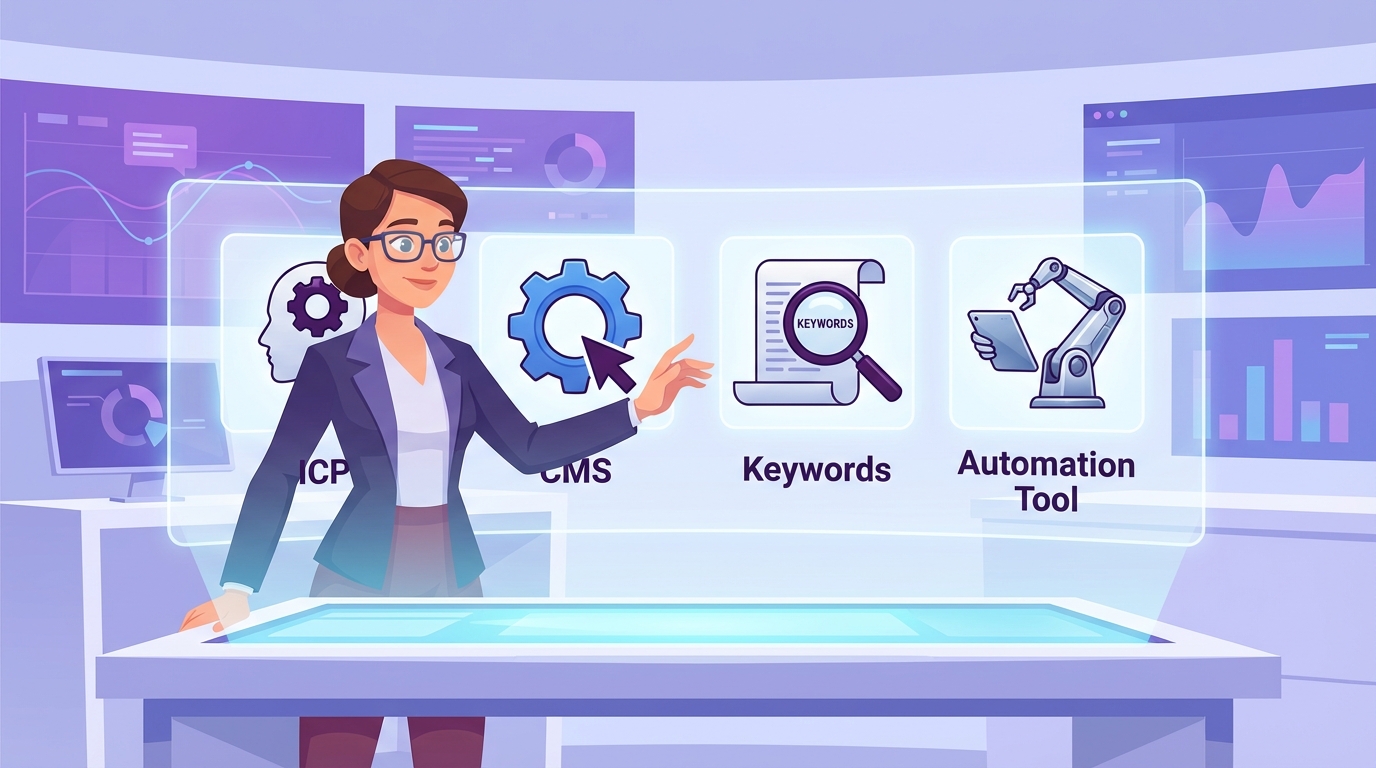 A visual guide to the essential prerequisites for launching a SaaS content automation strategy.
- A Defined ICP (Ideal Customer Profile): You must know exactly who you are targeting (e.g., CTOs at mid-market fintech firms) to ensure the AI generates relevant topics.
- CMS Access: You need administrative access to your website platform, such as WordPress, Webflow, or Shopify, to enable API-based auto-publishing.
- Seed Keyword List: A list of 5-10 "pillar" topics that define your software's core value proposition.
- An Automation Toolset: Access to an all-in-one platform like Better Blog AI or a combination of tools like Ahrefs (for data), ChatGPT (for drafting), and Zapier (for distribution).
Phase 1: Automated Keyword Research and Gap Analysis
The foundation of any B2B strategy is identifying what your potential customers are searching for. Manual keyword research is often the biggest bottleneck, taking hours of filtering through spreadsheets.
The Strategy: Identifying High-Intent Gaps
In B2B SaaS, you should prioritize "Bottom-of-Funnel" (BOFU) keywords. These are queries where the user is actively looking for a solution, such as "best CRM for real estate" or "alternatives to Salesforce." Automation allows you to scan thousands of these queries simultaneously.
The Tactics: How to Automate Research
- Competitor Gap Analysis: Use an API-driven tool to pull the top 100 keywords your competitors rank for that you do not.
- Keyword Clustering: Group these keywords into "clusters" automatically. For example, "how to track sales," "sales tracking software," and "sales pipeline automation" should all be targeted in a single, comprehensive guide rather than three separate posts.
- Difficulty Filtering: Set your automation parameters to ignore any keyword with a difficulty score above 40 if your domain authority is low. Focus on the "low-hanging fruit."
The Result: Validation
Success in this phase looks like a 60-day content calendar populated with 30-60 high-intent keywords that have a clear path to ranking on page one of Google.
Phase 2: SaaS Content Writing and Programmatic Generation
Once you have your keywords, you need to produce the content. According to research by Ryan Law at Ahrefs, marketers using AI publish 42% more content than those who do not. This volume is critical for SaaS companies trying to establish topical authority.
SaaS Content Writing: Moving Beyond Manual Drafts
Traditional B2B writing involves a lengthy cycle of briefs, first drafts, and multiple rounds of revisions. To automate this, you must move to an "Editor-in-Chief" model where the AI does the heavy lifting and a human provides the final 5% of polish.
Using Better Blog AI for Production
Better Blog AI streamlines this by conducting its own deep research into Google and Ahrefs data before writing. It doesn't just guess what to write; it analyzes the top-ranking results to ensure the structure, word count, and keyword density match what Google already rewards.
- Structural Optimization: The system automatically generates H2 and H3 headers based on "People Also Ask" (PAA) data.
- Infographic Generation: One of the biggest hurdles in B2B content is visual data. Automation tools can now create relevant infographics and charts to accompany the text, increasing the "dwell time" of readers.
- Internal Linking: The tool identifies existing pages on your site and creates intelligent internal links, which is a critical factor for boosting site authority.
The Importance of Human-in-the-Loop
While the generation is automated, the most successful SaaS companies use a human to add "Information Gain." This means adding unique insights, specific customer stories, or proprietary data that an AI cannot know. This ensures the content is not only SEO-friendly but also high-authority and publication-ready.
SaaS Content Marketing B2B: The Automation Framework
B2B content marketing differs from B2C because the buying cycle is longer and involves multiple stakeholders. Your automated strategy must address the entire buying committee, from the end-user to the CFO.
Mapping Content to the Buying Committee
- The End-User: Needs "How-to" guides and tactical advice (e.g., "How to automate data entry in Excel").
- The Manager: Needs "Best of" lists and comparison guides (e.g., "Top 10 project management tools for 2026").
- The Executive: Needs ROI-focused whitepapers and case studies (e.g., "The economic impact of migrating to the cloud").
By automating the creation of these different content types, you ensure that no matter who enters your funnel, there is a piece of content designed to convert them. Industry expert Lari Numminen demonstrated the power of this approach in an enterprise SEO case study, showing how a company achieved 22x organic traffic in a year by switching to a generative AI-driven content model.
SaaS Content Marketing Examples: Programmatic and AI Success
Looking at real-world applications helps illustrate how automation functions at scale. Several SaaS companies have already pivoted to these models with significant success.
UserPilot: The Template-Driven Model
UserPilot, a product growth platform, struggled with slow content output until they pivoted to a template-driven programmatic approach. By focusing on bottom-of-funnel keywords and using structured templates for their content production, they were able to triple their output. This allowed them to dominate search results for specific software categories very quickly.
Markettailor: Rapid Scaling
Markettailor, a B2B website personalization tool, used AI-generated content to supercharge their strategy. Within just two months, they produced a massive volume of high-quality SEO content that would have taken a human team over a year to complete. This rapid scaling is the primary advantage of automation; it allows a startup to compete with established giants by sheer volume and speed.
AIContentfy: From Zero to Scale
AIContentfy itself is a prime example. As a SaaS tool for companies wanting to scale SEO, they used their own AI-generated content to grow from zero to a significant traffic base in a very short window. Their success proves that when the AI is fed the right data and structured correctly, Google treats the content as high-authority.
SaaS Content Marketing Strategy Example: A 90-Day Roadmap
If you are starting from scratch, here is exactly how your automated strategy should look over the first three months.
Month 1: The Foundation
- Week 1: Connect your CMS to Better Blog AI.
- Week 2: Perform a "Competitor Gap Analysis" to find 50 keywords your rivals rank for.
- Week 3: Set up your "Autopilot" schedule to publish 3 articles per week.
- Week 4: Review the first 12 articles for brand voice and technical accuracy.
Month 2: Scaling Output
- Week 5-8: Increase publishing frequency to 5 articles per week.
- Focus: Shift from general "How-to" topics to "Alternative to [Competitor]" and "Best [Category] Software" posts.
- Automation: Enable automated internal linking to ensure new posts pass "link juice" to your core product pages.
Month 3: Optimization and ROI
- Week 9-12: Analyze which automated posts are gaining the most impressions in Google Search Console.
- Tactics: Use the AI to "refresh" the top-performing posts with more data or updated screenshots.
- Result: By the end of day 90, you should have 60+ high-quality articles live, with initial organic traffic beginning to trend upward.
SaaS Content Marketing Agency vs. In-House Automation
Many founders wonder if they should hire a SaaS content marketing agency or build an automated in-house system.
The Agency Model
- Pros: High-touch strategy, professional writers, hands-off for the founder.
- Cons: Extremely expensive ($3,000–$10,000 per month), slow turnaround, often requires months to see results.
- Best for: Large enterprises with massive budgets who need highly specialized thought leadership.
The Automation Model (Better Blog AI)
- Pros: 90% lower cost, 10x faster production, data-driven SEO accuracy, operates 24/7.
- Cons: Requires an initial setup phase, needs a human "editor" for final quality checks.
- Best for: Early to mid-stage SaaS companies that need to scale traffic and leads quickly without hiring a full marketing department.
For most B2B SaaS companies, the hybrid approach is best: use automation for 80-90% of your SEO content (the "bread and butter" traffic drivers) and save your human budget for 10% high-level thought leadership or original research.
SaaS Content Marketing Course: Learning the Automation Stack
If you want to master this skill, you don't necessarily need a formal degree. The "SaaS content marketing course" of the future is actually a series of technical competencies.
- Prompt Engineering: Learning how to give AI specific instructions to produce B2B-grade content.
- SEO Data Analysis: Understanding how to use tools like Ahrefs or SEMrush to find "low-difficulty" opportunities.
- Workflow Integration: Learning how to use APIs or tools like Zapier to connect your content generator to your website and social media channels.
- Conversion Rate Optimization (CRO): Learning how to place "Calls to Action" (CTAs) within automated content to turn readers into trial users.
SaaS Content Marketing Reddit: Community Insights on Automation
The Reddit community, particularly in subreddits like r/SaaS and r/SEO, often debates the ethics and efficacy of automated content. The consensus among successful founders is clear: quality matters more than the "source" of the writing.
- The "Death of SEO" Myth: Many Redditors claim SEO is dead because of AI. However, data shows that Google continues to rank AI content as long as it provides value and answers the user's query.
- The "Spam" Warning: The community warns against "low-effort" AI spam. Simply hitting "generate" on a basic prompt will not work. You must use a tool that incorporates real-time search data and structural optimization.
- The Programmatic Advantage: Founders on Reddit frequently share "build in public" stories where programmatic SEO (creating thousands of pages for specific locations or integrations) led to their first 1,000 users.
Phase 3: Automated Distribution and Internal Linking
Creating the content is only half the battle. To rank in B2B search, your content must be indexed and connected to the rest of your site.
Automated Internal Linking
Internal links tell Google which pages are the most important. Better Blog AI automates this by scanning your entire blog library and inserting links to relevant older posts within your new content. This creates a "web" of authority that helps all your pages rank higher.
Distribution Workflows
Once a post is published, you can automate its distribution:
- Social Media: Use a tool to automatically pull the headline and link and post it to LinkedIn and Twitter.
- Email Newsletters: Set up an RSS-to-Email automation that sends a weekly digest of your new blog posts to your lead list.
- Slack/Discord: Automatically notify your internal sales team when a new "Comparison Guide" is live so they can use it in their outreach.
Phase 4: Troubleshooting Common Automation Issues
Even with the best tools, you may encounter obstacles. Here is how to handle them.
Issue: Content Feels Too Generic
If the AI-generated content sounds like every other blog post, you need to feed it more "context."
- Solution: Provide the tool with your specific product features, unique selling points (USPs), and a few examples of your brand's "voice" (e.g., "professional but conversational").
Issue: Pages Are Not Indexing
Sometimes Google is slow to recognize new automated content.
- Solution: Ensure your sitemap is automatically updating. Use the Google Search Console API to "request indexing" for new URLs as soon as they are published.
Issue: High Bounce Rate
If people are landing on your site but leaving immediately, your content might not be matching their "search intent."
- Solution: Review the headers. Ensure the answer to the user's question is in the first two paragraphs. Use the BLUF (Bottom Line Up Front) method for every post.
Frequently Asked Questions
What is the SaaS content marketing strategy?
A SaaS content marketing strategy is a systematic approach to creating and distributing valuable, relevant content to attract and retain a clearly defined B2B audience. Unlike traditional marketing, it focuses on solving user problems and demonstrating software value through SEO-optimized articles, case studies, and product guides to drive trials and subscriptions.
What is the 3 3 2 2 2 rule of SaaS?
The 3 3 2 2 2 rule refers to the growth expectations for a successful SaaS startup aiming for a venture-scale exit. It suggests that a company should triple its annual recurring revenue (ARR) for two consecutive years, and then double it for the following three years (Triple, Triple, Double, Double, Double). Content automation is often the only way to scale marketing fast enough to meet these aggressive targets.
What is SaaS marketing?
SaaS marketing is the process of promoting and selling "Software as a Service" products. It differs from traditional product marketing because it focuses on recurring revenue, reducing churn, and increasing the Lifetime Value (LTV) of a customer. It relies heavily on digital channels, particularly organic search and educational content, to move prospects through a complex B2B funnel.
What is the 70 20 10 rule in content marketing?
The 70 20 10 rule is a framework for resource allocation in content strategy. It suggests that 70% of your content should be "proven" content that drives steady traffic (like automated SEO posts), 20% should be "premier" content that is more experimental or high-effort, and 10% should be "high-risk" content that tests entirely new formats or ideas.
Final Steps for Implementation
Automating your B2B SaaS content marketing is no longer a luxury; it is a competitive necessity. By moving away from manual drafting and embracing an AI-driven, programmatic approach, you can achieve the scale required to dominate your niche.
To get started today, follow these three steps:
- Audit your current output: Determine your current cost-per-article and publishing frequency.
- Choose your automation partner: Sign up for a platform like Better Blog AI to handle the research, writing, and linking.
- Launch a pilot program: Commit to publishing 20 automated, high-intent articles over the next 30 days and monitor the impact on your Google Search Console impressions.
Once the system is running, your role shifts from "creator" to "strategist," allowing you to focus on building your product while your content engine builds your audience.
📺 Watch & Learn
For a visual walkthrough, check out this related video: