
To build a B2B SaaS content strategy, identify your ideal customer profile (ICP) pain points, map these to your product's "Jobs to be Done," and execute a high-frequency publishing schedule that balances search-optimized educational guides with bottom-of-funnel comparison pages. This process typically takes two to four weeks to document and requires a combination of keyword research data and internal subject matter expertise. By aligning every piece of content with a specific stage of the buyer’s journey, you transform your blog from a simple traffic source into a predictable revenue engine.
Content marketing for software companies has shifted significantly heading into 2026. According to research from Contentful, while almost every B2B SaaS team now utilizes AI, the technology itself has not changed the necessity of high-quality outcomes. Success now depends on how well you integrate AI efficiency with human oversight to maintain a distinct brand voice.
In this guide, you will learn the exact framework for building a scalable content engine. We will cover everything from initial research and framework selection to automated execution using Better Blog AI and measuring tangible business outcomes.
Prerequisites for a Successful SaaS Strategy
Before you begin drafting articles, you must have specific foundational elements in place. Skipping these steps often leads to "random acts of content" that drive traffic but fail to generate trials or demos.
Ensure you have the following:
- A Documented ICP: You must know exactly who you are writing for, including their job title, company size, and the specific software they are looking to replace.
- Product-Led Keywords: A list of terms your customers use when they are looking for a solution like yours.
- A Content CMS: A platform like WordPress, Webflow, or Ghost where you can publish and manage your library.
- Analytics Setup: Google Analytics 4 or a product analytics tool like Mixpanel to track conversions from specific blog posts.
- AI Automation Tools: A platform like Better Blog AI to handle the heavy lifting of keyword gap analysis and high-volume drafting.
saas content strategy b2b: The Strategic Foundation
A high-performing saas content strategy b2b focuses on solving problems rather than just describing features. In the B2B world, the sales cycle is longer and involves multiple stakeholders. Your content must speak to the end-user (the practitioner) and the decision-maker (the executive).
Defining Your Content Pillars
Content pillars are the broad topics your brand wants to own in the minds of your audience. If you sell project management software, your pillars might be "Remote Team Collaboration," "Agile Methodologies," and "Resource Planning."
To build these pillars:
- Audit your product features and group them into 3-5 logical categories.
- Cross-reference these categories with high-volume search terms.
- Identify the "unmet needs" in current search results where your product provides a unique solution.
Mapping the Buyer’s Journey
B2B buyers move through three distinct phases, and your strategy must address each:
- Awareness (Top of Funnel): The buyer realizes they have a problem. Content here should be educational and broad (e.g., "Why your team is missing deadlines").
- Consideration (Middle of Funnel): The buyer is looking for solutions. Content here should be tactical (e.g., "How to implement agile workflows").
- Decision (Bottom of Funnel): The buyer is comparing specific tools. Content here should be direct (e.g., "[Your Product] vs. [Competitor]").
content frameworks for SaaS Growth
Using established content frameworks prevents your team from starting from scratch every month. Frameworks provide a repeatable structure for your editorial calendar.
The 70-20-10 Rule
This framework helps you balance risk and reward in your content production:
- 70% Proven Content: This is your "bread and butter" SEO content. It targets keywords you know your audience searches for.
- 20% Experimental Content: This includes deep-dive thought leadership, original research, or new formats like interactive calculators.
- 10% High-Risk/High-Reward: This is contrarian content or "viral" plays that challenge industry norms.
The 3-3-2-2-2 Rule of SaaS
This rule focuses on the distribution of your content types to ensure a healthy funnel:
- 3 Top-of-Funnel (ToFu) educational posts.
- 3 Middle-of-Funnel (MoFu) tactical guides.
- 2 Bottom-of-Funnel (BoFu) comparison or "Best of" lists.
- 2 Product-focused updates or case studies.
- 2 Distribution-first pieces (e.g., LinkedIn-native carousels).
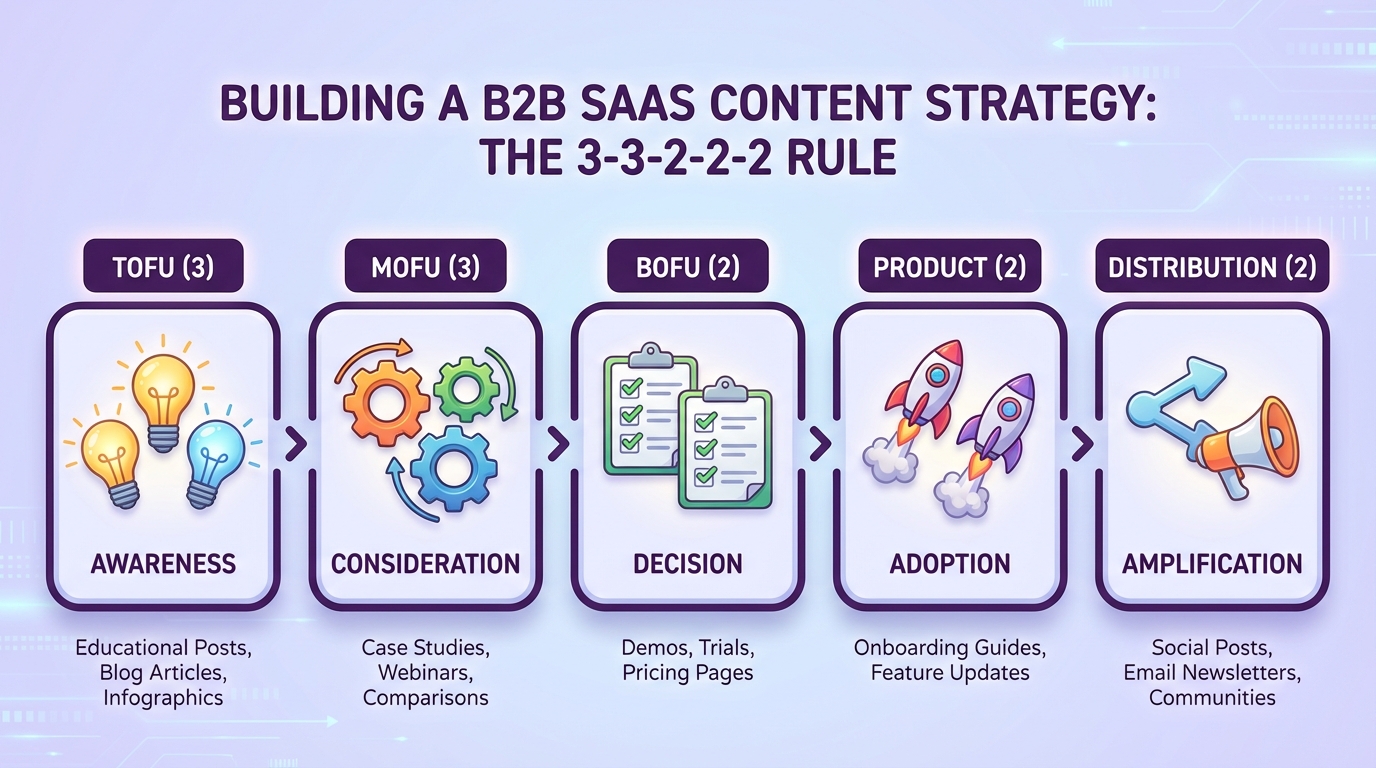 Figure 1: The 3-3-2-2-2 SaaS Content Distribution Framework
The Jobs to be Done (JTBD) Framework
Instead of focusing on demographics, focus on the "job" the customer is hiring your software to do. According to Averi.ai, documented brand voice and strategic alignment are hallmarks of success, with 64% of top-performing content marketers using a documented strategy. The JTBD framework ensures your content remains aligned with the user's actual goals.
saas content marketing: Execution and Scaling
Once the strategy is set, saas content marketing becomes a game of consistency and quality. The primary challenge for most SaaS founders is maintaining a high publishing frequency without sacrificing the technical depth required for B2B audiences. To bridge this gap without increasing your headcount, Better Blog AI automates the research and drafting process so you can maintain technical authority at scale.
Leveraging AI for High-Volume Production
Modern SaaS teams are moving away from manual drafting for every single post. Better Blog AI allows you to automate the entire SEO lifecycle. The platform conducts keyword research by analyzing Google and Ahrefs data to find gaps your competitors have missed.
To scale effectively:
- Automate Keyword Research: Use AI to identify low-competition keywords that have high intent.
- Generate Structured Drafts: Use AI to create the initial structure, ensuring it follows SEO best practices like H2/H3 nesting and keyword placement.
- Human Oversight: As noted by Montana Thomas at Quick Sprout, AI supports your strategy but does not set it. Every AI-generated piece should be reviewed by a subject matter expert to ensure technical accuracy.
- Automated Internal Linking: Use tools to automatically link new posts to your high-converting landing pages, boosting your site's overall authority.
Generative Engine Optimization (GEO)
As we move into 2026, traditional SEO is evolving into GEO. According to Gracker.ai, B2B SaaS companies must optimize for how AI search engines (like Perplexity or Google’s Gemini) summarize information. This means your content must be highly structured, factual, and provide direct answers to complex questions early in the text.
saas content strategy example: A Practical Walkthrough
To understand how this looks in practice, let's look at a saas content strategy example for a hypothetical B2B platform called "FlowState," which sells time-tracking software for creative agencies.
Phase 1: The Core Pillar
FlowState identifies "Agency Profitability" as their main pillar. They know that if an agency can't track time, they can't bill accurately.
Phase 2: The Content Mix
- Awareness: "10 Reasons Your Creative Agency is Losing Money" (Targeting broad agency owners).
- Consideration: "The Ultimate Guide to Agency Resource Management" (Targeting operations managers).
- Decision: "FlowState vs. Harvest: Which is better for large agencies?" (Targeting the final decision-maker).
Phase 3: The Results
By publishing three times per week using an automated engine like Better Blog AI, FlowState covers 150+ niche keywords in a single quarter. This "content moat" makes it difficult for competitors to outrank them for long-tail queries related to agency management.
saas content marketing examples from Top Brands
Looking at successful saas content marketing examples can provide inspiration for your own roadmap.
1. HubSpot: The Educational Giant
HubSpot pioneered the "Inbound" methodology. Their strategy relies on creating massive amounts of top-of-funnel educational content. They don't just sell CRM software; they teach you how to do marketing. This builds immense trust before a user ever sees a product demo.
2. Canva: The Template-Led Growth
Canva uses a "Product-Led" content strategy. They have thousands of pages optimized for keywords like "how to make a flyer" or "presentation templates." The content is the product. When a user lands on the page, they are immediately invited to use a template, leading to a high sign-up rate.
3. Ahrefs: The Product-in-Action Strategy
Ahrefs rarely writes a blog post that doesn't feature their own tool. They show, rather than tell, how to solve SEO problems using Ahrefs. This is a highly effective B2B tactic because it educates the user while simultaneously demonstrating the product's value.
saas content strategy pdf: Creating Your Internal Document
Every founder needs a saas content strategy pdf or internal wiki that the entire team can reference. This document ensures that whether you are using an in-house writer, an agency, or an AI tool, the output remains consistent.
Your strategy document should include:
- Brand Voice Guidelines: Is your tone "The Wise Professor" or "The Helpful Peer"?
- Formatting Standards: Rules for header usage, bolding, and list structures.
- SEO Checklist: A list of must-haves for every post (e.g., meta descriptions, alt text, internal links).
- Conversion Goals: What is the "Next Best Action" for every post? (e.g., Sign up for a newsletter, start a free trial).
- Distribution Plan: Where does the content go after it is published? (e.g., LinkedIn, Slack communities, email).
content marketing for small business SaaS
If you are a solo founder or a small team, you cannot compete with HubSpot on volume. Content marketing for small business requires a more surgical approach.
Focus on "Zero Volume" Keywords
Traditional SEO tools often show "0" search volume for highly specific, technical queries. However, these are often the exact questions your best customers are asking. By answering these "un-searchable" questions, you can capture high-intent traffic that competitors are ignoring.
The "Autopilot" Model
Small teams should leverage automation as much as possible. Better Blog AI is specifically designed for this scenario. It executes a 30-60 day content calendar that publishes directly to your CMS daily. This allows a small team to maintain the presence of a much larger marketing department without the high overhead of an agency.
best saas marketing agencies vs. AI Automation
When deciding how to execute your strategy, you generally have three choices: hire an in-house team, hire one of the best saas marketing agencies, or use an AI-powered platform.
When to Hire an Agency
Agencies are excellent for high-level brand positioning and complex creative campaigns. If you need a full rebrand or a high-budget video series, an agency is the right choice. However, they are often expensive and can be slow to produce the volume of SEO content needed to move the needle in organic search.
When to Use Better Blog AI
For founders who need to scale organic traffic quickly and efficiently, Better Blog AI offers a superior ROI. It handles the repetitive, data-driven tasks of SEO, keyword research, gap analysis, and structural optimization, at a fraction of the cost of an agency. This allows you to focus your human energy on high-level strategy and product development.
Troubleshooting Common Content Strategy Issues
Even with a perfect plan, you may encounter hurdles. Here is how to handle them:
- Traffic is growing, but conversions are flat: This usually means your content is too broad (ToFu) and not enough of it is focused on the product (BoFu). Shift your calendar to include more "alternative to" and "how to use [Product] for [Task]" articles.
- Content is not ranking: Check your technical SEO. Ensure your site speed is high and your internal linking structure is logical. Also, verify that you are targeting keywords within your site's "Domain Authority" range.
- AI content feels generic: This happens when you don't provide enough "Information Gain." Add original data, unique screenshots, or personal anecdotes to your AI-generated drafts to give them a human edge.
Frequently Asked Questions
What is the SaaS content strategy?
A SaaS content strategy is a comprehensive plan for creating, publishing, and distributing content designed to attract, engage, and convert software users. Unlike general content marketing, it focuses heavily on the "subscription" model, meaning content must not only drive initial sign-ups but also provide ongoing value to reduce churn and encourage expansion.
What is the 70 20 10 rule for content?
The 70 20 10 rule is a framework for resource allocation in content marketing. 70% of your content should be low-risk, "evergreen" SEO content that drives steady traffic. 20% should be "premier" content that is more in-depth or experimental. The final 10% should be high-risk, innovative content designed to disrupt the market or go viral.
What is the 3 3 2 2 2 rule of SaaS?
The 3 3 2 2 2 rule is a distribution framework for a 12-piece content cycle. It suggests publishing 3 educational posts, 3 tactical guides, 2 competitor comparisons, 2 product updates, and 2 pieces designed specifically for social media distribution. This ensures a balanced funnel that addresses every stage of the buyer's journey.
What are the 5 C's of content?
The 5 C's of content are Context, Consistency, Creativity, Connectivity, and Conversion.
- Context: Ensuring the content is relevant to the reader's specific problem.
- Consistency: Maintaining a regular publishing schedule to build trust.
- Creativity: Offering a unique perspective that stands out from competitors.
- Connectivity: Using internal and external links to build authority and guide the user.
- Conversion: Including a clear call to action that moves the user toward a business goal.
Building for the Future of B2B SaaS
Building a B2B SaaS content strategy is no longer just about writing blog posts; it is about building a scalable system that combines data-driven insights with automated execution. By focusing on your ICP's pain points and leveraging tools like Better Blog AI, you can create a content moat that protects your brand and drives predictable growth.
To recap the process:
- Document your ICP and map their "Jobs to be Done."
- Select a framework like the 70-20-10 rule to balance your output.
- Use AI to automate keyword research and initial drafting to maintain high frequency.
- Review every piece for technical accuracy and brand voice.
- Distribute your content across the channels where your buyers actually spend their time.
Your next step is to conduct a content audit of your existing site. Identify which pillars are currently underserved and use those gaps to form the basis of your next 30-day content calendar. For founders looking to skip the manual labor, starting an autopilot engine with Better Blog AI is the fastest way to begin seeing organic growth.
📺 Watch & Learn
For a visual walkthrough, check out this related video: